
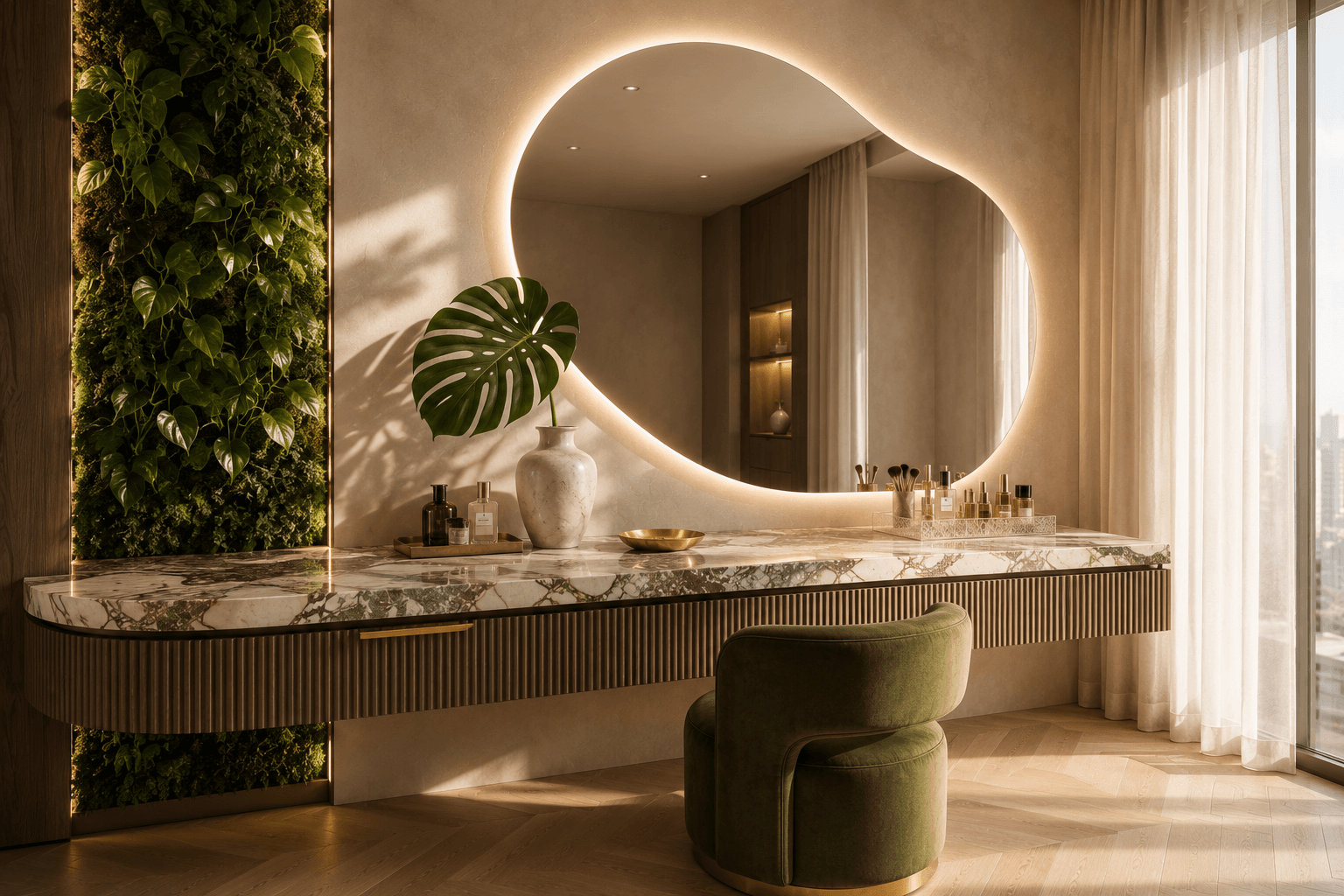
A bedroom corner where a lit living-plant column grows beside a cloud-shaped halo mirror, over a breccia marble counter whose plum-and-moss fragments echo both the foliage and the olive velvet stool — biophilic design at dressing-table scale.
The idea behind it
The living wall is treated as architecture: a full-height timber-framed column with hidden reservoir cassettes and its own light strip, positioned in the periphery of the mirror where greenery calms without blocking.
Stone links garden to furniture — the breccia slab's moss and plum fragments pick up leaf and stool alike, making one composition of wall, counter and seat. The fluted taupe drawers deliberately stay quiet beneath the busy stone.
Light is split by subject: the cloud halo lights the face, the wall strip feeds the plants, sheers diffuse the city window — three systems, one warm temperature, separate switches.
What you will need
Living wall column, A timber-framed cassette system with self-watering reservoir and trailing species.
Cloud-shaped halo mirror, An organic wide mirror with warm backlight.
Breccia marble top, A fragment-patterned slab in plum, moss and cream tones.
Fluted taupe drawers, A floating ribbed unit with slim brass pull.
Olive velvet stool, A curved stool echoing the foliage in fabric.
Grow-light strip, Warm horticultural LED on a timer inside the plant column.
Stone vase + monstera leaf, One sculptural leaf bridging counter and wall.
Sheer curtains, Diffusing the window so plants and face share soft light.
Steal the look
Step 1
Frame a 40–60 cm wide floor-to-ceiling column beside the vanity wall for the cassette system.
Step 2
Install the self-watering cassettes, plant pothos/philodendron/moss, and wire a warm grow strip on a timer.
Step 3
Hang the fluted unit at 73–75 cm and top with the breccia slab.
Step 4
Mount the cloud mirror with its centre at seated eye height; halo on a dimmer.
Step 5
Keep 10–15 cm clearance between foliage and counter edge.
Step 6
Style minimally: tray, one vase with a monstera leaf, brass bowl.
Step 7
Add the olive stool; check the composition reads as one from the doorway.
Step 8
Set a monthly trim reminder and a fortnightly reservoir top-up.
Perfect for
- Plant lovers who want greenery beyond pots
- City bedrooms starved of garden views
- Anyone whose mornings need a calmer start
- Homes with warm, bright (or timer-lit) corners
Avoid if
- You travel for weeks at a time — living walls need fortnightly attention
- The corner gets neither daylight nor room for a grow light
- You want zero-maintenance styling
- Busy stone patterns aren't your taste — breccia is bold
Estimated budget
Budget
DIY pocket planter panel with hardy pothos, breccia-effect laminate top, flat-pack fluted unit and a ready-made organic LED mirror.
$350-$900
Mid-range
Cassette living-wall kit with reservoir, quartz breccia-look slab, semi-custom fluted drawers and quality cloud mirror.
$900-$3,000
Luxury
Professionally installed irrigated green wall, genuine breccia marble, bespoke joinery and automated grow lighting.
$3,000+
Colour palette6 tones
Leaf Green
living wall
#5F7A3D
Moss Fragment
marble and stool
#8A8F62
Plum Vein
breccia accents
#7B4B52
Taupe Flute
drawer fronts
#B7A995
Warm Ivory
walls and halo
#EFE6D4
Soft Brass
pulls and bowl
#AD8D5A
Frequently AskedQuestions
Choose a cassette system with a self-watering reservoir (topped up every 1–2 weeks), hardy trailing species like pothos and philodendron, and a warm grow-light strip on a 10–12 hour timer if natural light is limited. Trim monthly; replace individual cassettes rather than the whole wall if a plant fails.
Not with a closed-reservoir system — there's no loose soil or drainage to splash. Keep a 10–15 cm gap between foliage and counter, choose non-shedding species, and wipe the slab weekly as you would anyway.
A stone formed from angular fragments naturally cemented together, giving a mosaic of colours — here plum, moss and cream. It's busier than veined marble, so it works best over plain fronts and beside genuinely organic elements like a living wall.
Join the conversation
Share your thoughts on this room.