
If making one coffee means crossing the kitchen four times, the problem is not your kitchen's size — it is that storage is organized by object type instead of by task. The 5-zone system, borrowed from professional kitchen design, puts every item within arm's reach of the place its job actually happens.
Why it works
Kitchens run on repeated micro-tasks: prep, cook, plate, wash, put away. When storage matches the task map, each task completes in one spot, and the endless criss-crossing that makes a kitchen feel chaotic simply disappears.
It also fixes the put-away problem. Things pile up on counters when 'away' is far from where you are standing; in a zoned kitchen, away is the drawer at your hip, so tidying happens as a side effect of cooking.
And it costs nothing. You are not buying organizers or remodeling — you are relocating contents between cabinets you already own. Most kitchens can be fully re-zoned in one afternoon.
How to do it
Step 1
Map your five zones on paper: consumables (food), non-consumables (dishes, glasses), cleaning (sink area), preparation (your main counter run), cooking (hob and oven).
Step 2
Label each existing cabinet and drawer with the zone it physically sits in — the zones are set by your kitchen's layout, not by where things currently live.
Step 3
Empty one zone at a time and evict everything that belongs to a different zone. Do not reorganize within the cabinet yet; just sort by zone.
Step 4
Reload each zone by frequency: daily items at hip-to-eye height, heavy pans in deep drawers at the hob, cleaning supplies under the sink, boards and knives at the prep counter.
Step 5
Put food in one place only. Split pantries (snacks here, tins there) are why you buy triplicates — consolidate into the consumables zone with like-with-like shelves.
Step 6
Test it for a week of normal cooking, then move the two or three items that still feel wrong. The kitchen tells you the correct home by where your hand goes first.
Keep organizing
- The Kitchen Counter Reset
- Open-Shelf Kitchen Organization That Stays Tidy
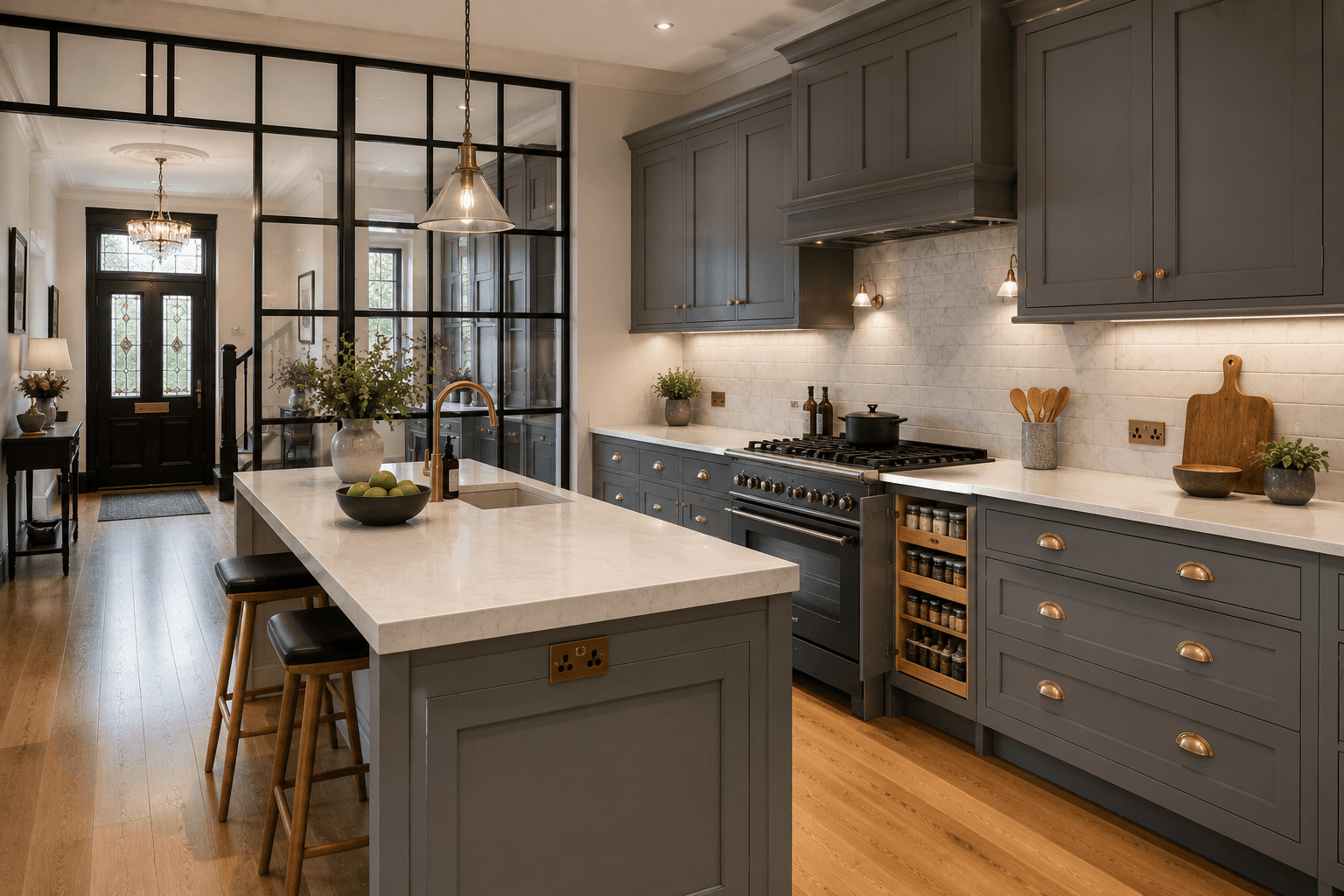
- The grey shaker kitchen pictured here
Hand-picked guides and room designs that pair well with this project.
Frequently AskedQuestions
Consumables (food), non-consumables (dishes and glassware), cleaning (sink and supplies), preparation (counters, knives, boards), and cooking (hob, oven, pans, utensils). Each item should be stored in the zone where it is used.
Yes — arguably better, because zones overlap naturally when everything is close. Even in a galley you can keep pans at the hob end and dishes at the sink end, which is the whole principle at miniature scale.
Deep drawers next to or under the hob win: you see every pan from above and lift it out in one motion, instead of crouching and excavating a low cupboard stack.
Nearest to where drinks happen — beside the fridge or the sink/water tap, not across the room with the plates. If people constantly walk through your prep area for water, that is the signal to move them.
Get the look
Room Designsto Steal

Join the conversation
Share your thoughts on this room.