
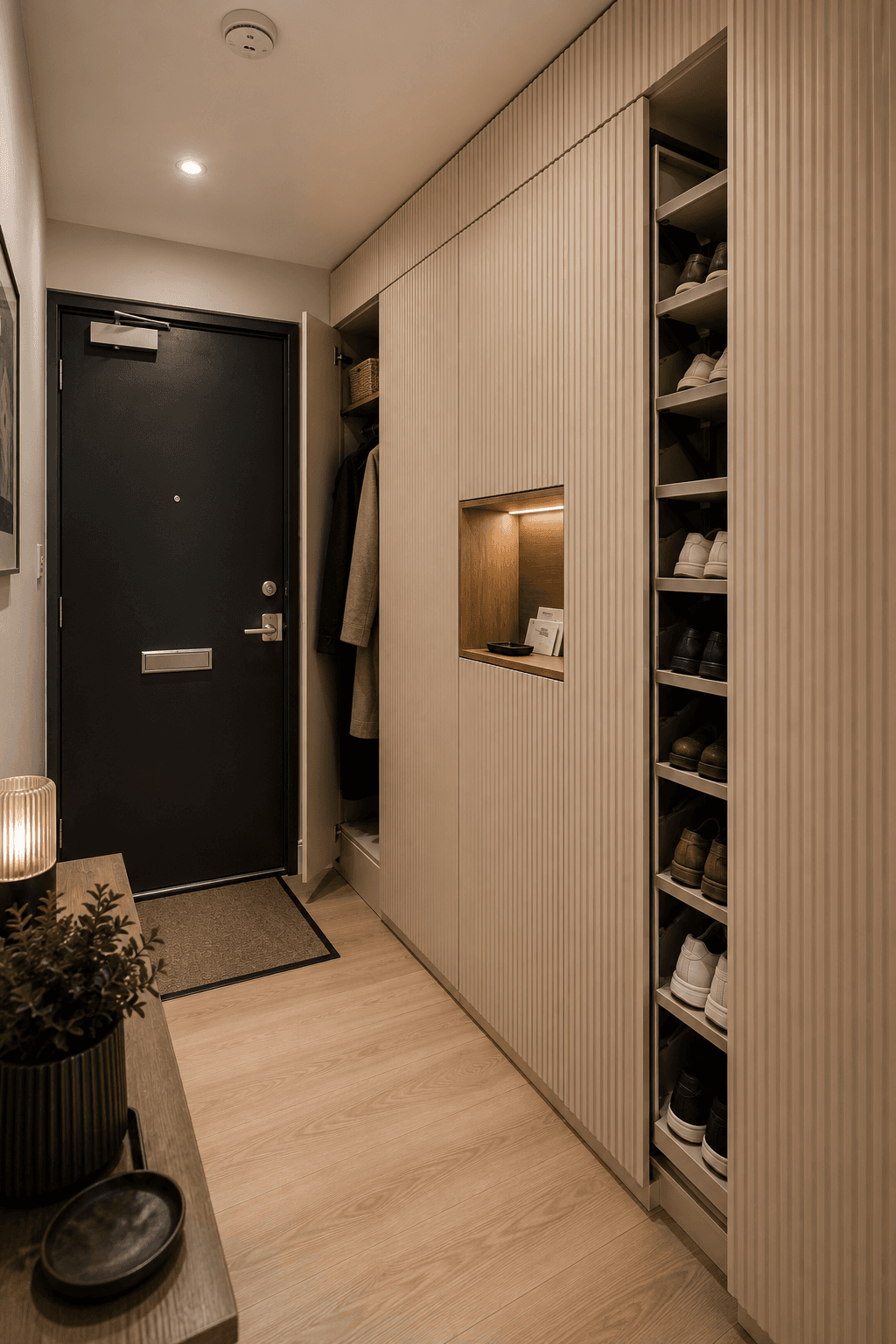
Shoe clutter is a geometry problem: standard cabinets are too deep for a narrow hall, so the shoes end up on the floor, and the floor is exactly what a narrow hall cannot spare. The fix is a slim tilt-out tower, wall-mounted everything else, and one blunt rule about how many pairs get door privileges.
Why it works
Tilt-out cabinets store shoes nearly vertically, cutting the required depth to 17–22cm — about half a normal cabinet and thinner than most radiators. A full-height tower in that footprint holds a dozen-plus pairs while reading as a flat panel rather than furniture.
Going floor-to-ceiling matters in a hall because the only generous dimension a narrow hall has is height. A tall slim tower stores more than a wide low bench ever could, without taking a centimeter from the walking line.
But storage alone never beats the pile — the pairs-out rule does. Piles form when the door zone is the default home for every pair; capping it at two pairs per person removes the pile's legal residence, and the habit follows the rule within a week.
How to do it
Step 1
Measure your hall's clear walking width; anything that leaves less than 80cm of passage is out, which usually rules out benches and standard cabinets immediately.
Step 2
Fit a tilt-out shoe tower (17–22cm deep) on the longest uninterrupted wall, floor to ceiling if ceiling height allows.
Step 3
Declare the two-pairs rule: each household member keeps the daily pair plus one alternate at the door; all other shoes move to wardrobes tonight.
Step 4
Assign one tilt-out row per person so putting shoes away requires zero decisions — even for kids.
Step 5
Mount a rail with hooks above or beside the tower at shoulder height for coats and everyday bags; skip the freestanding coat stand entirely.
Step 6
Tuck a slim boot tray beside or behind the door for wet shoes, and add a small wall shelf or tray for keys and mail so they never migrate to the kitchen.
Step 7
Do a thirty-second reset each evening: stray pairs go into the flap, wet pairs onto the tray.
Keep organizing
- The Mudroom Drop-Zone System
- Small Kitchen Storage: Vertical Tricks for Tight Galleys
- The fluted shoe-tower entryway pictured here
Hand-picked guides and room designs that pair well with this project.
Frequently AskedQuestions
Tilt-out shoe cabinets run 17–22cm deep — roughly half a standard cabinet — because shoes sit almost vertically behind the flap. That is shallow enough for halls where a normal 35cm unit would block the walkway.
Two per person: the current daily pair plus one alternate. Every additional sanctioned pair widens the pile; the rest of the collection belongs in bedroom wardrobes or under-bed boxes.
No — shoes rest on angled shelves inside the flap. Stiff boots and high-tops are the exception; store those on a boot tray or a wardrobe shelf rather than forcing the flap shut on them.
A rail with hooks at adult shoulder height for coats and bags, and a small shelf or tray for keys and mail. Wall storage costs zero floor depth, which is the scarcest resource in a narrow hall.
Get the look
Room Designsto Steal

Join the conversation
Share your thoughts on this room.